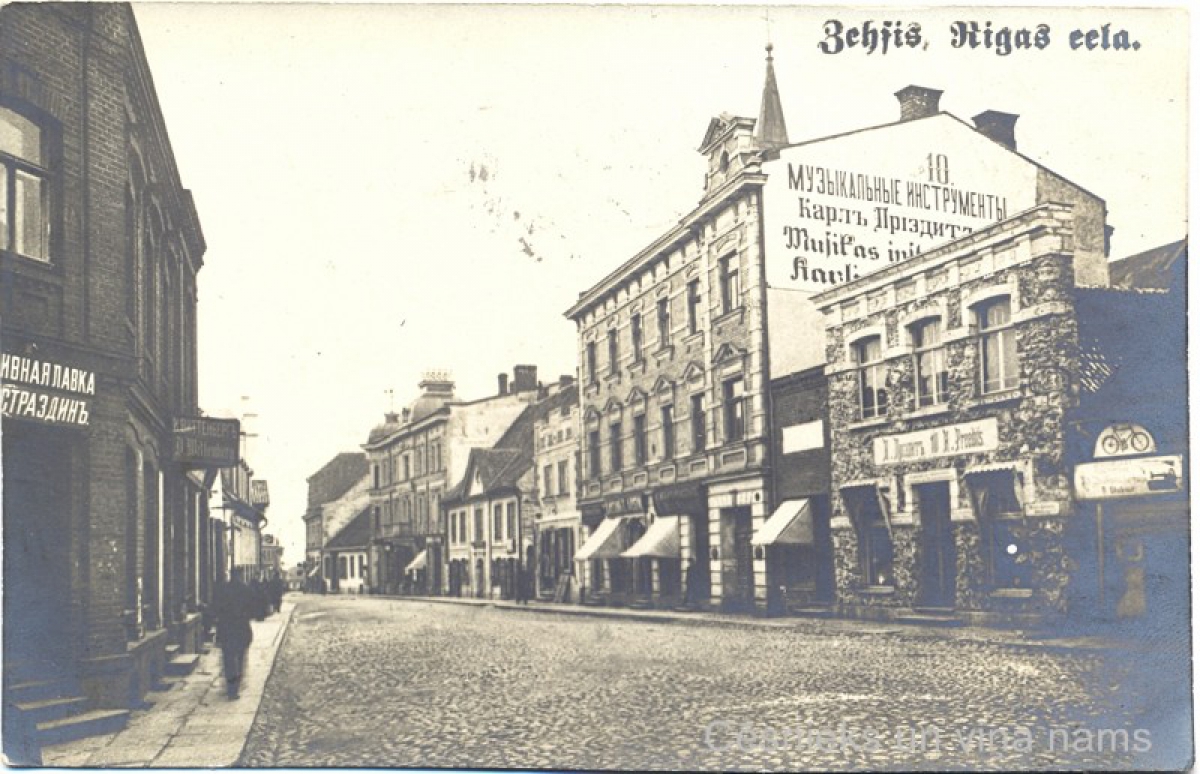
The two-storey stone building at 39 Rīgas iela, with the year “1924” on its front gable, has a much more colourful history than it might seem at first glance. It was once home to one of the most prominent dynasties of doctors in Cesis, but even earlier there was a modest one-storey wooden house at the end of which, in the year one thousand nine hundred and eighteen, a sign proclaimed a shoemaker's workshop. The history of the property dates back to the second half of the 18th century, when its first known owner was the master glazier Johann Christoph Wittmann.
After Whitman's death, the property changed hands several times over a period of about 30 years. First it was inherited by his widow Anna Helena Wittmann, then in 1806 it was acquired by the shoemaker Johann Andreas Taus, who sold it in 1815 to the Land Court lawyer Friedrich August Arct. It was he who ordered the demolition of the old wooden building and the construction of a new one. 1821. In 1827, the newly built building was purchased by the Land Court Assessor and Secretary von Thiesenhausen, who resold it to Charlotte von Rokasovskaya for the impressive sum of 2000 silver roubles.
1866. In 1828, the property was purchased at a public auction for 4,200 roubles by Dr. Peter Wilhelm Goetgen (1828-1920), an educated and experienced physician who studied at the University of Tērbat and furthered his knowledge in Berlin, Vienna and Prague. Before coming to Cesis, Goetgen worked as a military doctor in various places, including the Caucasus. He started practising in Cesis in 1862, and in 1870 he became the district doctor of Cesis and later became the senior district doctor of the Vidzeme province.
The Goetgen family lived in this house for several decades. On 17 November 1917, at the age of 91, the doctor made a will bequeathing the property to his daughter Ida. After his death on 13 October 1920, Ida Goetgen sold the property to Kārlis Migl in 1924 for 12,000 lats.
The new owner did not hesitate to change. Just a few months after the purchase, Migla mortgaged the property and borrowed money from the Bank of Latvia to build a new two-storey stone house on the site of the old wooden building. Today, the inscription "1924" adorns its facade. Migla borrowed additional funds, including LVL 12,000 from the Latvian Mortgage Bank, to continue the construction work. He set up his ironmongery shop on the ground floor, and rented out the rest of the premises to Alfreds Pauls' drug, chemical and perfumery shop.
Unfortunately, Migl was increasingly short of funds to cover his bank interest and bills. Several companies even went to court to collect their debts. The situation became so difficult that in 1937 Migla signed a sale and purchase agreement with the couple Alvīne and Jānis Gogi. Together with the building, they bought the inventory of the shop for a total of 28,000 lats. As they took over all of Migla's debts, the seller received just over a thousand lats in cash.
After the nationalisation of the house in autumn 1940, a grocery shop of the Cēsis Consumers' Association was set up in the building. During the German occupation, in 1943, the property rights were restored to the Gogi family, and they paid off all remaining debts. Unfortunately, after the arrival of Soviet troops in September 1944, the family lost the property once again. The historical significance of the building was appreciated in the post-war period - in November 1948 it was one of the first buildings in Cesis to undergo major renovation.
The materials used for the description are:
Dace Cepurīte, Mg. hist., Research “A Cēsis Native and His House”
Collections of the Cesis Castle Museum.