cēsu stāsti
LV / EN
Home / Cesis House /Butchers' House
Cesis House

Butchers' House

Time · 1773.-1944. g. Audio · audio story
Listen to the story

Interesting facts

The house has been involved in the meat trade from the very beginning, and this tradition continued for centuries, despite the fact that various irregularities were often found in the produce of the traders.

In 1903, an easement was established over the property in favour of the building at 32 Rīgas iela, as the end walls of the two houses shared a saddle roof - an interesting solution that shows how architectural and practical issues were dealt with in urban planning at the time.

There was also an amusing incident - a lady had forgotten her velvet hat at the hairdresser's at 34 Rīgas iela, and could get it back by paying for an advertisement in the newspaper. The equivalent of the “lost property office” of the time!

Facts

1773: Michael Heijns, a carpenter and butcher, bought a plot of land from Johann Friedrich Meisel, a master craftsman, and built a stone dwelling house

1816: The property was inherited by Heijn's daughter, Sophie Kathrin, wife of the butcher and butcher Peter Ernest Wap

1829: The house and garden outside the Katrina Gate were bought for 850 silver roubles by the butcher and carpenter Kārlis Fridrihs Stelz

19th century. 1970s-1980s.

1886: After the death of Theodor Gangus, the property is divided between his widow Anna Gangus and his widow Ekaterina Frey Gangus

1896: Anna Ganguss carved out a small plot of land and sold it to the merchant David Berzins

1903: The property has an easement in favour of the building at 32 Rīgas Street

1916: During the First World War, on the orders of the Commander-in-Chief of the Northern Front, the property of Anna Gangus is placed under sequestration

Early 20th century: J. Cēders' meat and sausage shop was located in the gate addition.

1927: the tiger trapper Līkums opened his shop in the building

1927 December: the “Meat and Sausage Shop” is opened by E. Vīgants

1932 January: the landlord put an ad in the paper for a shed for rent

1932 February: the meat and sausage shop is opened by the firm “Bērziņš”

1933: J. Jägeris rented the premises for a meat and sausage shop

1935 January: owner of a meat shop Jēkabs Jēgeris fined LVL 50 for selling unfit sausages

1936: Karlīna Jēgeris fined LVL 20 for selling unfit sausages

20th century. 30. Early 1990s: the building was the shoe workshop of Mrs M. Anderson

20th century. 30. years: the workshop was rented by watchmaker K. Andersons

1937: The house was the home of M. Blūms' hairdressing salon, where Alise Zariņa worked

20th century. 30. years: on the second floor of the Artillery Instructor Battery, tailor Stankevich opened a special uniform workshop

In September 1944, an air raid destroys the house

Today: the plot belongs to the Hesburger brand holders

The story

The history of 34 Rīgas Street dates back to the second half of the 18th century. 1773. In 1910, the butcher and butcher Michael Heijn bought a plot of land from the Varkal master Johann Friedrich Meisel and built a stone dwelling house on it. It is interesting to note that the house has been connected with the meat trade from the very beginning, and this tradition continued for centuries.

In 1816, according to the decision of the magistrate of Cesis, the property was inherited by Heijns' daughter, Sophie Kathrin, who was married to the carpenter and butcher Peter Ernest Wapp. In the following years, the property continued to change hands until, in 1829, the house and the garden outside Katrin's Gate were purchased for 850 silver roubles by the butcher and carpenter Karl Friedrich Stelz.

In the second half of the 1817 century, the house changed hands several times. In the 1870s-1880s, the owner of the plot was Theodor Gangus. After his death, interesting changes in the structure of the property began. 1886. In 1910 the property was divided between the widow Anna Gangus, née Freya, and the widow Ekaterina Freya Gangus, née Lutz. Anna Gangusa received the stone house with the land belonging to it.

Anna Gangusa was apparently a shrewd and thrifty person, because in 1896 she separated a small plot of land from her property and sold it to a merchant, David Jēkabs' son Bērziņš, who added it to his neighbouring property at 32 Rīgas iela.This transaction was connected with the landlady's financial difficulties - in 1886 she had borrowed 9000 roubles from the Cesis Savings and Loan Fund, and the sale of the plot helped to repay the loan. However, her financial manipulations did not end there, because in 1899 she borrowed another 4000 roubles from the Vidzeme Town Mortgage Society.

Interestingly, Anna was also obliged to pay 1 rouble annually to the Lutheran pastor of the town, according to an entry in the mortgage book of the magistrate of Cesis on 24 January 1855. Such payments are a testimony to the traditions of the time and the role of the church in the administration of the town.

The building has not lost its significance in the early 20th century. As in other buildings, the space was rented out for shops and apartments. Butcher's shops and sausage shops have a particularly vivid history in the building. 20. At the beginning of the century, the gate annex housed J. Cēdera's meat and sausage shop. 1927. Līkums opened its wing here in 2007.

The police, in the presence of a veterinary surgeon and a representative of the town council, carried out a health check and found two half-headed pigs that had died. Soon after this incident, in December of the same year, E. Vīgants opened a “meat and sausage shop” here. And just like today, there were sales, during which 1 pound (400 grams) of “first-quality rendered pig fat” could be bought for 80 santims (40 Latvian roubles).

In January 1932, a landlord placed an advertisement in the newspaper that a pigsty was for rent at 34 Rīgas Street. In February, the firm “Bērziņš” opened a meat and sausage shop. In his shed, as the autumn season began, beef prices dropped: “first-quality soup meat from 10 santims (400 grams), shirogale from 24 santims, fresh beer sausages for 20 santims”. At the same time, Voldemārs Bērziņš of 34 Rīgas Street was found to be selling unfit sausages, for which he was prosecuted.

The building was used not only by butchers, but also by other professions. 1930. At the beginning of the 1990s, there was also a shoe workshop at 34 Rīgas Street, owned by Mrs M. Anderson. When it was moved to 10 Rīgas iela, the workshop was rented by the watchmaker K. Andersons. The building also housed a “gentlemen's and ladies” hairdressing salon “. A ladies” haircut cost 80 santims, “hot eyebrow colouring - 80 santims, manicure - 50 santims”.

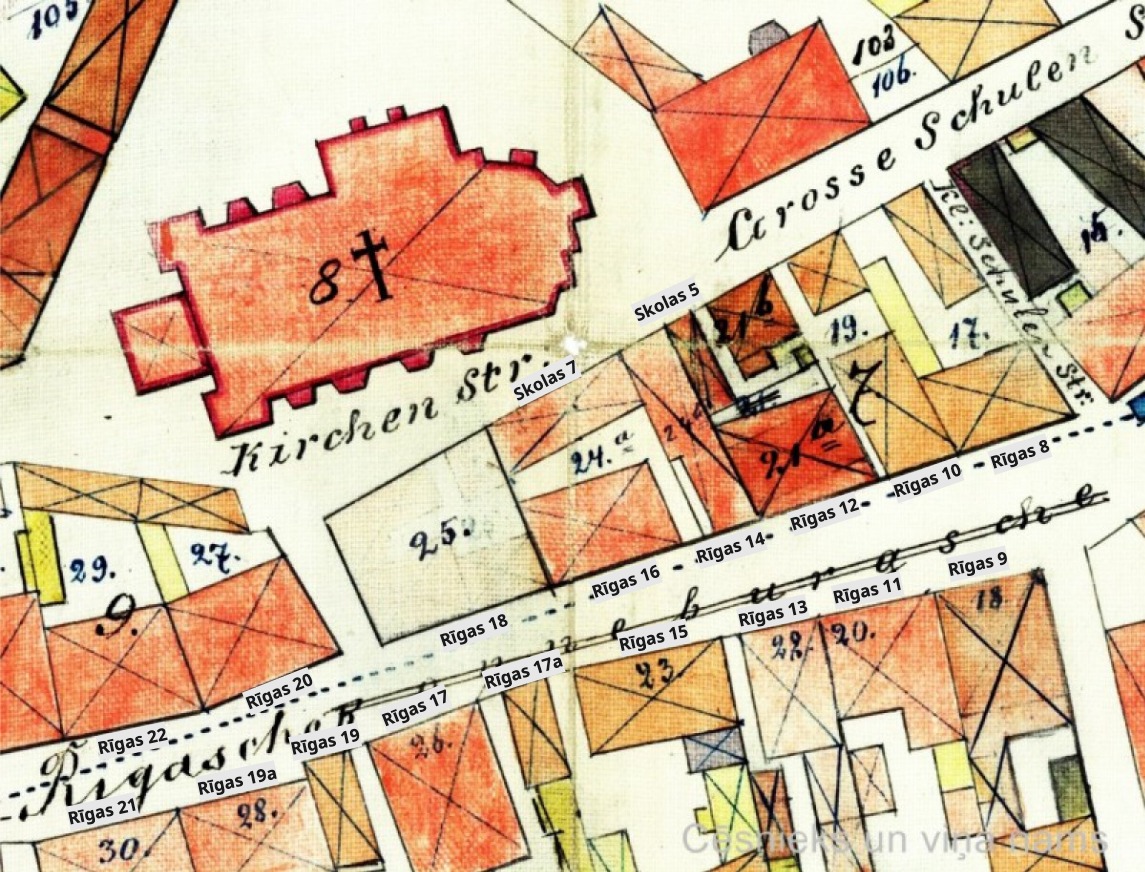
Unfortunately, the life of the house ended in September 1944 as a result of an air raid by the Bolshevik army. Several attempts have been made to restore the building, including the construction of a Hesburger restaurant, but this has not been successful due to the architectural requirements of the city to restore the building to its original appearance.

The materials used for the description are:

Dace Cepurīte, Mg. hist., Research “A Cēsis Native and His House”

Collections of the Cesis Castle Museum.
Timeline of events

1773
Namnieks un miesnieks Mihaels Heijns nopirka gruntsgabalu no varkaļu meistara Johana Fridriha Meisela un uzcēla mūra dzīvojamo māju
1816
Īpašumu mantoja Heijna meita, namnieka un miesnieka Pētera Ernesta Vāpa sieva Sofija Katrīna
1829
Dzīvojamo māju un dārzu ārpus Katrīnas vārtiem par 850 sudraba rubļiem nopirka namnieks un miesnieks Kārlis Fridrihs Štelcs
1886
Pēc Teodora Gangusa nāves īpašums sadalīts starp atraitni Annu Ganguss un atraitni Jekaterinu Freiju Gangusu
1896
Anna Ganguss atdalīja nelielu zemes gabalu un pārdeva tirgotājam Dāvidam Bērziņam
1903
Īpašumam noteiktas servitūta tiesības par labu ēkai Rīgas ielā 32
1916
Pirmā pasaules kara laikā, pēc Ziemeļu frontes virspavēlnieka pavēles, Annas Gangus īpašumam uzlikts sekvestrs
1927
Ēkā savu skārni atvēra tigotājs Līkums
1927
gads decembris: "Gaļas un desu pārdotavu" atvēra E. Vīgants
1932
gads janvāris: Namsaimnieks ielika sludinājumu avīzē, ka izīrējams skārnis
1932
gads februāris: Gaļas un desu tirgotavu atvēra firma "Bērziņš"
1933
Telpas gaļas un desu tirgotavai īrēja J. Jēgeris
1935
gads janvāris: Gaļas tirgotavas īpašnieks Jēkabs Jēgeris sodīts ar Ls 50 par nederīgu desu tirgošanu
1936
Karlīna Jēgeris sodīta ar Ls 20 par nederīgu desu tirgošanu
1937
Namā atradās M. Blūma frizētava, kurā strādāja Alise Zariņa
1944
gada septembrī aviouzlidojuma rezultātā nams iet bojā
19.gs. 70.-80.gados: Gruntsgabala īpašnieks bija Teodors Gangus
20.gs 20'to gadu sākums: Vārtu piebūvē atradās J. Cēdera gaļas un desu veikals
20.gs. 30. gadu sākums: Ēkā darbojās M. Andersona kundzes apavu darbnīca
20.gs. 30. gadi: Darbnīcu īrēja pulksteņu meistars K. Andersons
20.gs. 30. gadi: Otrajā stāvā Artilērijas instruktoru baterijas drēbnieks-piegriezējs Stankevičs atvēra speciālu formas apģērbu darbnīcu
Mūsdienās: zemesgabals pieder Hesburger zīmola turētājiem
Location
Cēsis
Object on map