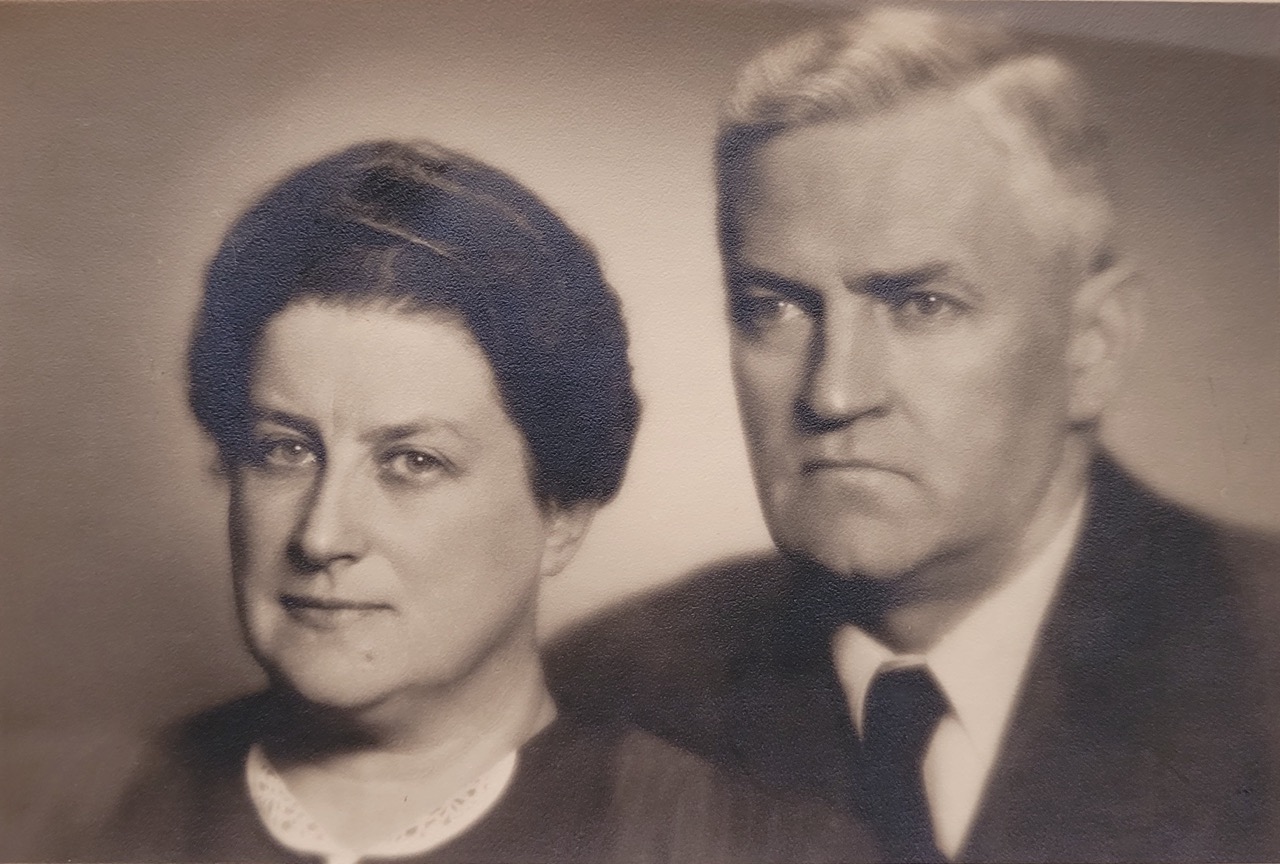
At Rucka Manor near Cēsis, on 28 February 1878, a boy was born into a modest manor servant family — a boy destined to become one of the most versatile figures in Latvian culture: Pāvils Gruzna. His talent showed itself across countless creative fields, making him one of the most colourful personalities in Latvian cultural life of his time.
Pāvils's parents, Juris and Made Gruzna, were simple but intellectually minded people. His father Juris, a servant-class man, worked at the time as a coachman for parish judge von Engelhardt at Rucka Manor, while his mother Made (born Miezīte) was a servant at the same manor. Later, his father became a bell-ringer at Cēsis Orthodox Church, then learned the trade of a cloth dyer, and eventually became a farmer in Kalsnavа Parish. Growing up in modest circumstances, Pāvils was the eldest of 5 children — 4 sons and 1 daughter.
His path in education took Pāvils Gruzna from his home region to Riga, where he studied at the Orthodox Ecclesiastical School and later at the Ecclesiastical Seminary. But the priesthood was no fit for this young rebel, and in his final year at the seminary he was expelled for "free thinking". Interestingly, it was only during the years of Latvian independence that Gruzna briefly studied at the University of Latvia, before his work at the Bank of Latvia got in the way.
After his expulsion from the seminary in 1898, Gruzna found work at the Riga branch of the Russian State Bank, where he stayed until World War I. During the war he was evacuated with the bank's staff to Tula in Russia, where he spent 5 years. 1920. In 1920, back in his homeland, he continued working at the Bank of Latvia until 1938, when he retired on a rather impressive monthly pension of 515 lats.
Alongside this day job, Gruzna was drawn irresistibly to the world of art. His artistic life was as vivid as an autumn maple leaf. Blessed with an outstanding tenor voice, Gruzna formed a popular quartet around 1900 together with Pāvuls Jurjāns, Pauls Sakss, and Jānis Kornets. At the same time he studied singing under Pāvuls Jurjāns, Pierre Lange, and Sander, and studied music theory and conducting under Nikolajs Alunāns.
From 1902 to 1912, Gruzna was involved in Riga's theatre scene as an actor and singer. He first performed at the New Riga Latvian Theatre, where he sang the role of Gomez in Conradin Kreutzer's opera "Das Nachtlager in Granada" at the theatre's opening night. He later played the role of Siebel in Charles Gounod's opera "Faust", Fenton in Otto Nicolai's "The Merry Wives of Windsor", and Eisenstein in Johann Strauss's "Die Fledermaus". Gruzna also performed at the Auseklis and Apollo theatres. During the years of Latvian independence he briefly worked at Dailes Theatre, organised a choir, and conducted the "Pērkons Choir", founded by students of Riga Ecclesiastical Seminary. He also sang in the Reiter Choir, occasionally stepping in for Teodors Reiter himself as conductor.
Gruzna made his entrance into literary life in 1904 with his first art reviews and the novella "Migla", published in "Dienas Lapa". In the early stage of his writing he was connected with the decadent publication "Dzelme" and the impressionist movement. Those who knew him recall that Gruzna had a distinctive style — he wrote in short, punchy, very lively sentences, conjuring up whole pictures, feelings, and moods with just a handful of words. His language was sharp, biting, and so unlike anything ordinary that you could recognise it in every sentence.
Pāvils Gruzna's literary legacy is impressive. He wrote more than 60 works — novels, short story collections, plays, and dramatisations. His creative range was wide — from realistic, at times even naturalistic portrayals of life to impressionistic visions, from strict documentary writing to fantasy and legend. His most significant works are the culturally and historically important novels "Bursaki" (1914, 1928, 1948) and "Jaunā strāva" (1946), which offer a valuable glimpse into the eras the author lived through.
Many of Gruzna's pieces remained scattered across various press publications — he published around 50 novellas and more than 100 feuilletons, as well as many reviews. His pen name Pe-Ge became widely known among readers. Gruzna wrote approximately 35 dramatic works, the most popular of which were: Ziedu grava, Kad jūra krāc, Ugunskrusta zīmē, Uz Brazīliju, Vecpuišu nodoklis, Pūra lāde, Mēmais zvans, and Linča tiesa. He also dramatised the Kaudzīte brothers' Mērnieku laiki and Augusts Deglavs's novel Rīga.
For the Latvian National Opera, Gruzna translated 17 operas and operettas, mainly works by Slavic and Russian composers. After retiring in 1938, Gruzna had hoped to devote himself entirely to art, but World War II put paid to those plans. During the German occupation (1941–1944), Gruzna was back at a day job — working as a dramaturgy officer in the theatre section of the Latvian Municipal Arts Department.
As the war drew to a close, Gruzna joined the many Latvians who fled as refugees to Germany. In exile he did not give up, continuing his creative work — teaching literature at Latvian refugee gymnasiums and writing the novel Jaunā strāva. His life ended on 12 December 1950 at an old people's home in Fårhus, Germany.
In his personal life, Gruzna was married to actress and singer Nadja Miški, who worked at the New, Dailes, and Touring theatres. They had a daughter, Ņina Gruzna, who later became a singer at Riga Radio and Valmiera Theatre. After his first wife's death in 1946, Gruzna married poet Marta Degaine (Brambergs) in 1947 at the Flensburg refugee camp.
Creative work (partial list)
1900: Privately studied singing under Pāvils Jurjāns.
1900: Formed a popular vocal quartet together with Pāvils Jurjāns, Pauls Sakss, and Jānis Kornets.
1901: Began writing, contributing reviews about Latvian everyday life to Russian newspapers.
1904: Published his first art reviews and the novella "Migla".
1905: Published his first fiction story "Migla" in a supplement to the newspaper "Dienas Lapa".
1911: Dramatised the Kaudzīte brothers' novel "Mērnieku laiki".
1912: Published the short story collection "Milzenis".
1914: Published the first version of the novel "Bursaki" in the journal "Domas".
1920–1930: Sang in Teodors Reiter's choir and occasionally stood in as conductor.
1921: Published the short story collection "Žults".
1921: Published the play "Kad jūra krāc…".
1922: Published the play "Ziedu grava".
1922: Published the feuilleton collection "Qui pro quo".
1923: Published the play "Uz Brazīliju".
1924: Published the short story collection "Svētlaimīgo sala".
1924: Published the plays "Mēmais zvans" and "Linča tiesa".
1926: Published the novel "Pēdējais latavis" in the journal "Domas".
1926: Dramatised Augusts Deglavs's novel "Rīga".
1928: Published the second version of the novel "Bursaki".
1933–1934: Published the novel "Jaunās strāvās" in the newspaper "Dienas Lapa".
1935: Published the play "Ugunskrusta zīmē".
1944: Published the play "Pūra lāde".
1946: Published the short story collection "Dzīves teiksmas".
1946: Published the novel "Jaunā strāva".
1948: Published the third version of the novel "Bursaki".
1948: Published the feuilleton collection "Feļetoni".
1978: Gruzna's unfinished novel "Mamona gaitnieki" was published in the USA, completed after the author's death by O. Liepiņš.
The materials used for the description are:
websites literatura.lv and LU akadēmiskās bibliotēka
publication Trimdas rakstnieki, No. 1 (1947);
the newspaper "Londonas avīze", No. 240 (19.12.1950);
the publication "Ilustrētais žurnāls", No. 3 (01.03.1928);
the newspaper "Tēvija", No. 33 (09.02.1942).